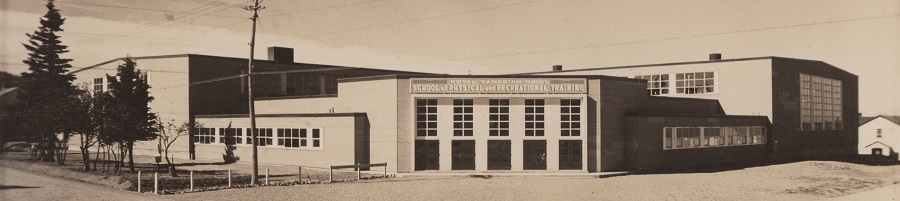
When the guns fell silent after the Second World War, many assumed that places like HMCS Cornwallis would simply fade into history.
But Cornwallis didn’t disappear.
Instead, it entered a new phase—one that reflected the shifting needs of a country moving from total war into an uncertain peace.
1945–1949: From Training Base to Transition Centre
At the end of the war, Cornwallis underwent an immediate transformation.
Rather than training recruits, it became a demobilization and discharge centre for thousands of returning sailors.
Men who had:
- Crossed the Atlantic under threat of U-boats
- Served aboard destroyers, corvettes, and supply ships
- Lived through years of war
…now passed back through Cornwallis on their way to civilian life.
Here, they:
- Completed paperwork
- Received medical assessments
- Were processed out of military service
For many, Cornwallis became the final chapter of their wartime journey—a place not of beginnings, but of endings.
1949: The Navy Returns
With the onset of the Cold War, the need for a trained military quickly resurfaced.
In 1949, Cornwallis reopened as a Royal Canadian Navy training establishment, once again taking in recruits.
But things had changed.
This was no longer a wartime rush to push men into combat. Training became:
- Longer
- More structured
- More professionalized
The focus shifted toward building a standing peacetime navy, ready for global commitments and NATO obligations.
1950s–1960s: A Modern Training Institution
Through the 1950s and 1960s, Cornwallis matured into one of Canada’s most important military training centres.
Training expanded to include:
- Advanced seamanship
- Technical trades (engineering, communications)
- Leadership development
It also became home to:
- The Boys’ Training Establishment (briefly), preparing younger recruits for naval life
- The Women’s Royal Canadian Naval Service (Wrens), whose members took on vital roles in administration and communications
Life at Cornwallis during this era still demanded discipline—but it also reflected a more modern military:
- Better living conditions
- More formalized instruction
- Increasing technical complexity
1968: Unification and a New Identity
A major turning point came in 1968 with the unification of Canada’s armed forces under the Canadian Armed Forces.
The separate navy, army, and air force were merged into one structure.
Cornwallis was redesignated as:
Canadian Forces Base Cornwallis
Its role expanded beyond naval training to become:
- The primary English-language recruit school for all branches
- A gateway into military life for thousands of Canadians
From this point on, soldiers, sailors, and air personnel all began their journeys in the same place.
1970s–1980s: The Gateway to Service
For the next two decades, Cornwallis became synonymous with basic training in Canada.
Recruits arriving at the base could expect:
- Intensive physical conditioning
- Drill and discipline
- Weapons handling
- Field exercises
But compared to wartime training, the emphasis had evolved:
- Greater focus on professionalism
- Standardized training across all services
- Preparation for both combat and peacekeeping roles
At its peak in this era, Cornwallis processed thousands of recruits every year, shaping the backbone of Canada’s Cold War military.
A Shift Toward Peacekeeping
As Canada’s global role evolved, so did the training philosophy at Cornwallis.
Increasingly, recruits were being prepared not just for war—but for:
- Peacekeeping missions
- International deployments
- Multinational cooperation
This shift reflected Canada’s growing identity on the world stage during the late 20th century.
1994: Closure and Transition
After more than 50 years of continuous service, Cornwallis closed as an active military training base in 1994.
Changing defense priorities and restructuring led to:
- The consolidation of training elsewhere
- The end of Cornwallis as a recruit school
But once again, the site did not simply vanish.
After Closure: A Civilian and Humanitarian Role
Following its closure, the former base found new life.
It became:
- A civilian training and education centre
- Home to the Pearson Peacekeeping Centre
- A site occasionally used for temporary housing during humanitarian efforts, including refugees during the Kosovo crisis
The same barracks that once housed recruits were now used to:
- Train peacekeepers
- Support international cooperation
- Provide short-term refuge to those in need
Legacy: A Place of Transformation
From 1945 onward, Cornwallis proved something remarkable:
It was never just a wartime necessity.
It adapted—again and again—to meet the needs of the moment:
- From demobilization centre
- To Cold War training hub
- To unified forces recruit school
- To peacekeeping and humanitarian support site
For generations of Canadians, Cornwallis marked a turning point in their lives.
Some arrived as nervous recruits.
Others passed through as veterans heading home.
Still others came later in search of peace, safety, or a new beginning.
Final Thought
Cornwallis didn’t just train soldiers.
It reflected Canada itself—
changing, adapting, and redefining its role in a rapidly shifting world.